


At a certain level in your career, the question is no longer whether you know how to dress for work. You do. You understand the expectations, you can identify what is appropriate in your industry, and you have likely built a wardrobe that reflects that understanding.
And yet, there is often a quiet trade-off taking place.
The more “correct” the wardrobe becomes, the less personal it feels. The more refined it is, the more it starts to resemble everyone else in the room. What begins as an effort to simplify and streamline gradually turns into a uniform that is technically polished, but increasingly disconnected from who you are.
It is the result of a pattern I see repeatedly: high-performing women optimizing for credibility by removing anything that could be misinterpreted. Personality becomes a variable to control, rather than an asset to leverage.
The intention is to be taken seriously. The outcome, more often than not, is that they are seen, but not distinctly remembered.
Why Blending In Stops Working
There is a persistent belief that neutrality creates authority. That if you minimize variation, stick to black, navy, and grey, rely on the same silhouettes, avoid anything that draws attention, you will be perceived as more credible, more focused, and more aligned with leadership.
In reality, neutrality does not create authority. It creates sameness.
In environments where everyone is highly capable, sameness does not work in your favor. It positions you as reliable, but not necessarily as the person who stands out when decisions are being made about who leads, who is trusted with more responsibility, and who is remembered after the meeting ends.
This is where the strategy begins to break down. The very choices meant to protect your professional image can quietly limit your visibility within it.
And over time, that limitation compounds. It shows up in missed opportunities, in slower progression, and in a subtle but persistent sense that you are not fully showing up as the person you know yourself to be.
A Different Approach to Authority
One of my clients, Kelly, is an executive at a major tech firm. When we first began working together, she had just completed what many would consider the ideal wardrobe reset. She had edited her closet down, built a neutral capsule, and created a system that removed decision fatigue from her mornings.
Everything was cohesive. Everything matched. Everything worked.
What was missing was any reflection of her.
Kelly is someone who is naturally drawn to color and print. There is a level of energy and presence to her that simply did not exist in her wardrobe anymore. In an effort to create ease, she had unintentionally erased the very elements that made her distinctive.
What we did was not a dramatic overhaul, but a deliberate reintroduction. We brought back color in a way that still felt grounded within her environment. We layered in print with intention, ensuring it complemented rather than competed. We explored silhouettes that felt expressive, while maintaining the structure required for her role.
The shift was gradual, but the impact was significant.
Over the course of two years, Kelly stepped into two promotions, expanding her scope from a national team to an international one. Her success is rooted in her performance, but her presence now fully reflects that level of capability. She is not just delivering results, she is showing up in a way that reinforces them.
She is remembered differently. She is engaged with differently. She is trusted at a higher level. That is the role personal style plays when it is used strategically.
Where Most Advice Falls Short
Much of the guidance around professional style is built on outdated assumptions. “Keep it neutral.” “Dress for the job you want.” “Don’t distract.”
While well-intentioned, these ideas lack nuance. They prioritize caution over clarity, and in doing so, they overlook the role that visual identity plays in leadership.
The goal is not to eliminate risk by blending in. The goal is to communicate, with precision, who you are and how you operate.
You are not dressing to match a title. You are dressing to reflect the level of impact you are expected to have. That includes how you lead, how you make decisions, and how others experience working with you.
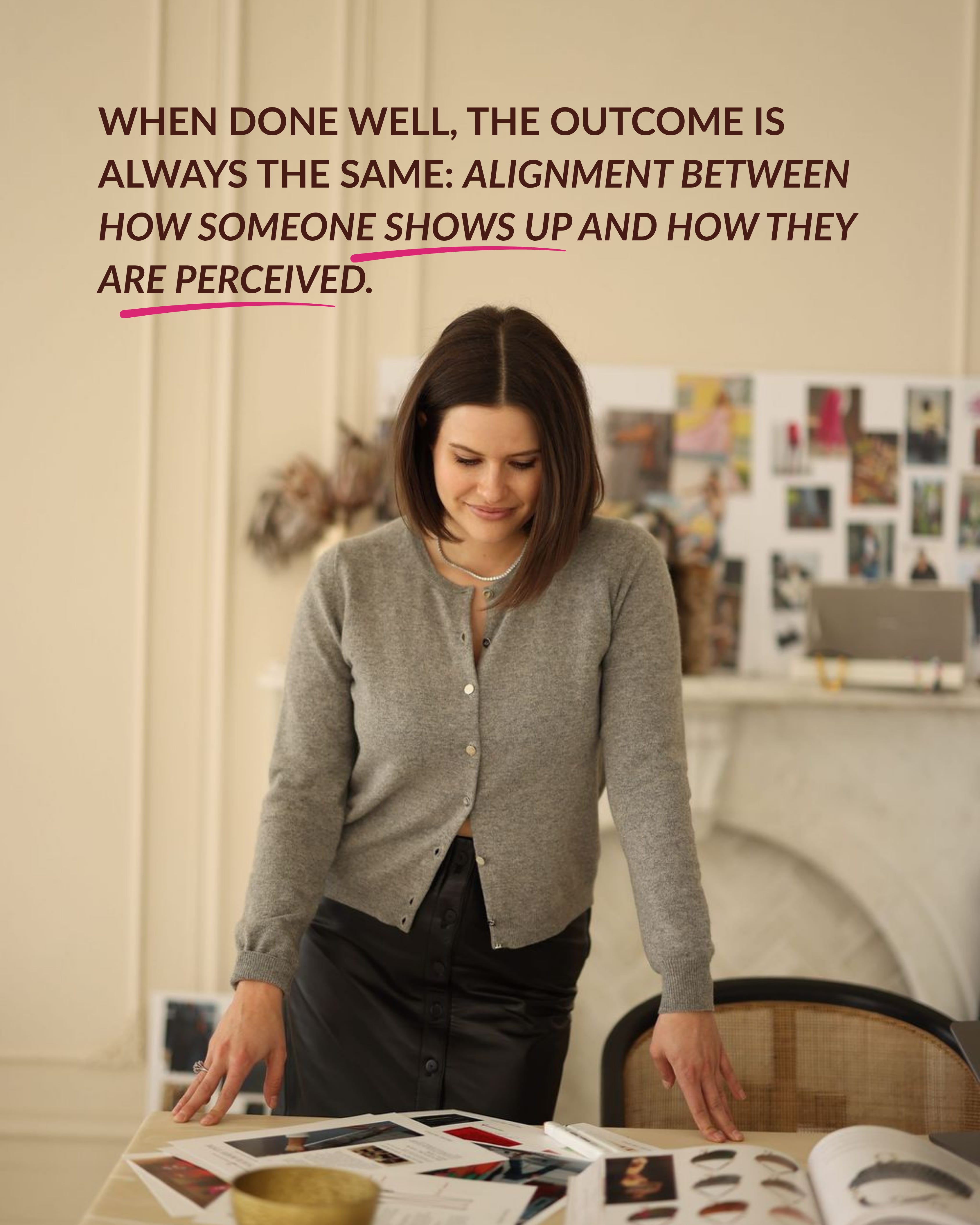
When this is done well, your wardrobe becomes an extension of your authority rather than a constraint on it. And here is how I do this for every client: