

We have been told for years that a good outfit needs a “pop.” A pop of color. A statement shoe. An interesting bag. One piece that gives the outfit a little something.
There is some truth to the idea. Every outfit needs visual interest. Where the advice falls short is in treating that interest as a single event.
When I am styling a client, I am rarely looking for the one piece that will make the outfit. I am looking at the outfit as a whole and asking a different question: Where does my eye go, and where does it go next?
The most compelling outfits give your eye somewhere to travel. Nothing is competing for attention, but nothing feels anonymous either. That movement is one of the reasons an outfit can feel polished without feeling dressed up.
Take the look below. The blazer is the obvious starting point: it has both color and texture, so it immediately gives the eye something to notice. But it doesn’t stop there. The scarf introduces another layer of interest. The sneakers add their own point of view. Even the jeans, which could easily disappear into an everyday outfit, feel intentional because of what they are doing in relation to everything around them.
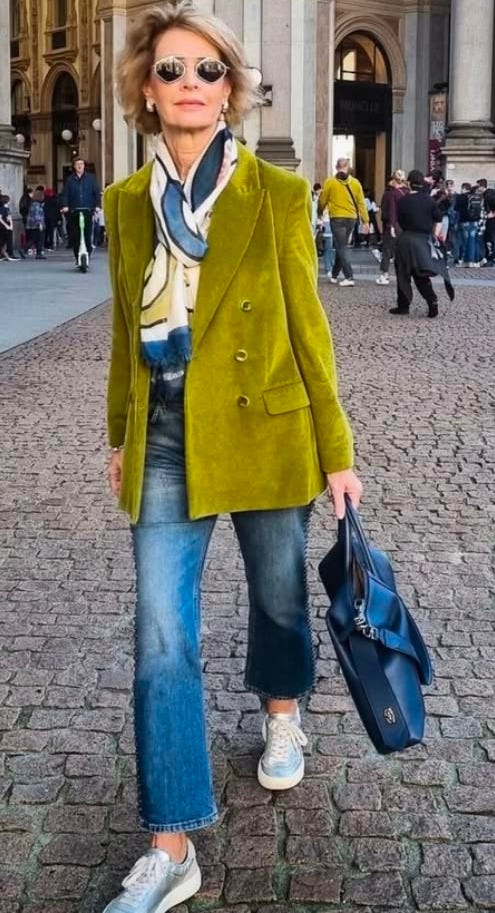
The outfit isn’t interesting because of one exceptional piece. It is interesting because the pieces keep a conversation going.
And this works just as well when color isn’t doing the heavy lifting.
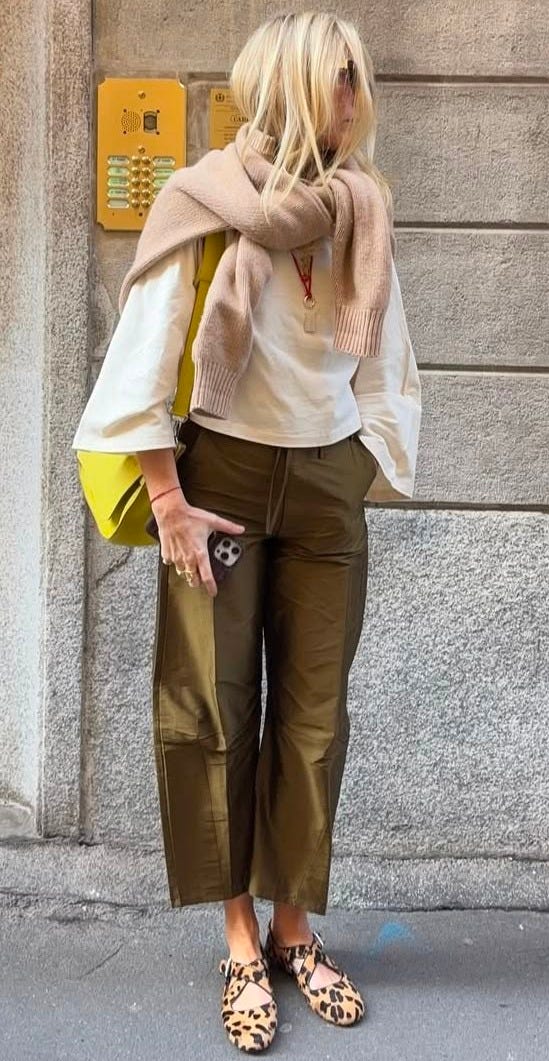
In the second look, the palette is considerably quieter, but the outfit doesn’t feel flat. The taffeta pants bring texture and movement. The printed shoes give the eye another place to land. A soft color peeks through the layers, while the proportions and layering create dimension. There is no single “wow” piece, yet the outfit feels remarkably complete.
The Power of 3 Method
This is one of the things I pay closest attention to when I am styling: an outfit needs enough visual information to feel intentional, but enough hierarchy to feel calm.
I call this my Power of 3.
There are four elements I look for when creating visual interest:
Color
Print
Texture
Structure
You don’t need all four. In fact, I often don’t want you to have all four. The goal is to have three working together, with one taking the lead and the others supporting it.
Think of it as a conversation rather than a checklist.
A textured jacket might lead, while a subtle print in the shoe and the structure of a great trouser support it. A bold color can be the starting point, while texture and silhouette give the rest of the outfit somewhere to go. In a neutral wardrobe, texture, print, and structure can create just as much dimension as color.
The important part is that the interest is distributed.
This is also why adding one more interesting thing to an outfit that feels unfinished doesn’t always solve the problem. If the rest of the outfit isn’t participating, you can end up with exactly the opposite of what you wanted: one statement piece surrounded by clothes that feel like placeholders.
The result can look overdressed rather than polished.
The distinction is subtle, but it is one I see constantly in client wardrobes. Polish doesn’t come from having more remarkable clothes. It comes from understanding how the clothes you already have relate to one another.
Once you start looking at an outfit this way, you can begin to diagnose that frustrating feeling of something is missing. Maybe you have plenty of color, but no texture to give it dimension. Maybe you have beautiful pieces, but everything is the same visual weight. Maybe you have a statement shoe, but nothing else in the outfit speaks to it.
You don’t necessarily need another piece. You need another point of connection.
That is the part of styling that is difficult to see when you are standing in front of your own closet. You are looking at individual garments and asking whether they are good. I am looking at the space between them and asking whether they are telling the same story.
And that, more than whether an outfit is casual or formal, is what makes it feel put together.
You can be wearing jeans and sneakers and look incredibly polished. You can be wearing a beautiful dress and still feel as though you haven’t quite arrived. The difference is rarely the level of dress. It is the level of intention.
When the color, texture, print, and structure are working together, your clothes begin to do something more than simply dress you. They create a visual shorthand for who you are: considered, confident, and entirely at home in what you’re wearing.
That is the feeling I am ultimately trying to create when I style a client: not the feeling that she is dressed up, but the feeling that her outside finally looks as assured as she feels on the inside.
Need a second set of eyes on your wardrobe? This is exactly the kind of work I do with my clients, helping you see the pieces you already own differently, identify what’s missing, and create outfits that feel intentional without requiring an entirely new wardrobe.
xx,