

Hot take: You can’t have a truly defined personal style without repeating yourself.
And I don’t mean wearing the exact same outfit every Tuesday because you’ve run out of ideas. I mean repeating the things that make an outfit feel like you: the proportions you consistently gravitate toward, the colors that keep finding their way into your wardrobe, the shoes you seem to wear with everything, the way you balance something tailored with something relaxed, or the particular level of polish that makes you feel most like yourself.
Personal style is built through those repeated decisions, even though we rarely think about it that way.
We tend to associate great style with novelty. We see a woman online who always looks incredibly chic and assume she must have an extraordinary ability to come up with a completely new outfit every time we see her.
But when you pay attention to women with genuinely recognizable style, something else is usually happening. The outfits change, but there is a consistency underneath them. You start to recognize the proportions, the restraint, the color palette, the way accessories are used. You develop a sense of what she is going to look good in before she even puts it on.
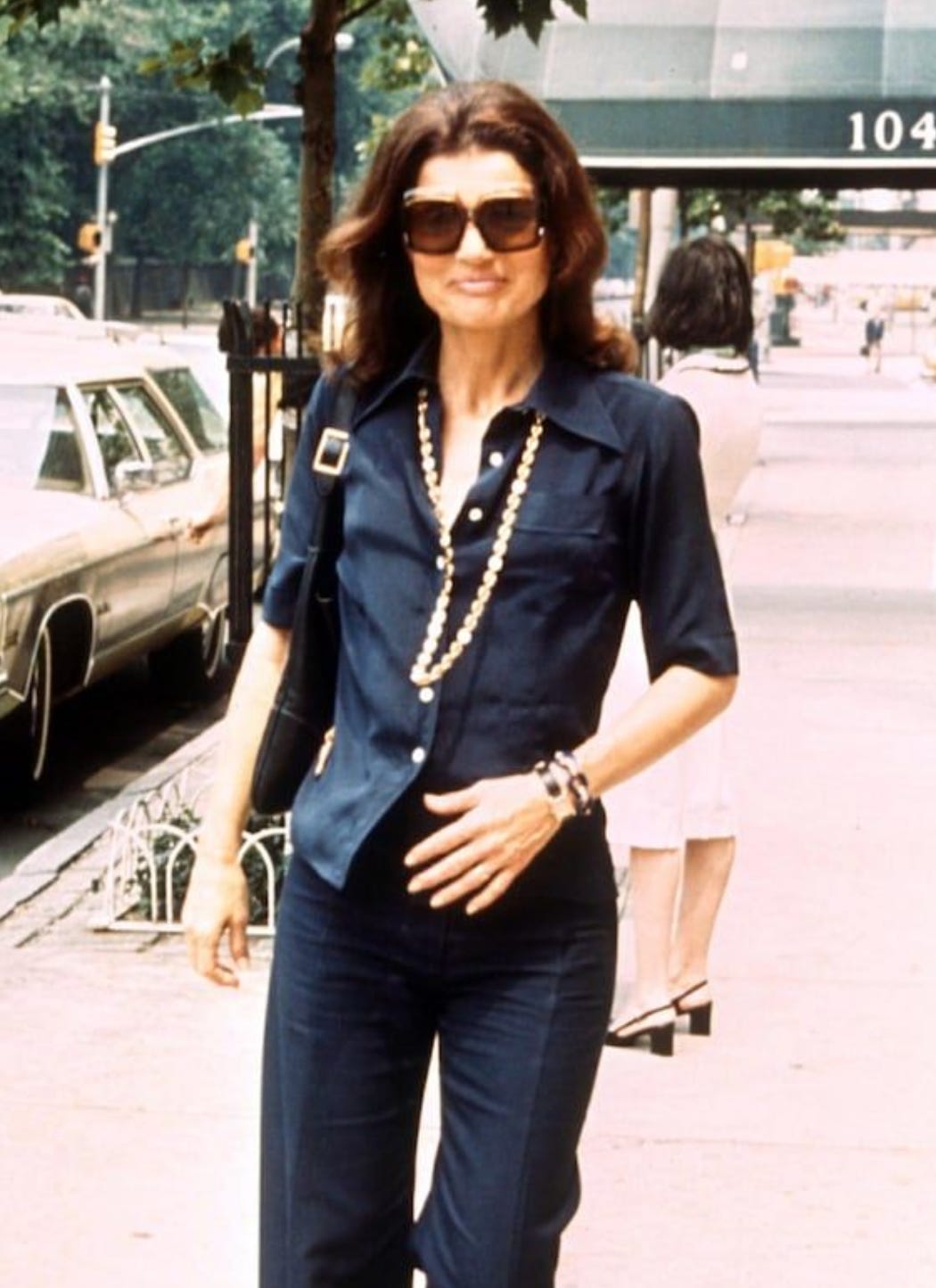
Jackie Kennedy Knew What Worked
Jackie Kennedy is probably the clearest example. The clean lines, the simplicity, the controlled color, the proportions, the sunglasses, the restraint.
Her style was not memorable because she was constantly surprising us. It was memorable because she was remarkably consistent about what she wanted her clothes to communicate.
You could see a photograph of her and recognize the sensibility immediately.
That distinction is important.
When a woman tells me she wants a signature style, she usually isn’t asking for a closet full of unusual pieces. More often, she is trying to achieve something much more elusive: she wants to feel like she knows what she is doing when she gets dressed. She wants to look polished without looking overly styled. She wants people to recognize her style without feeling as though she is wearing a uniform. And, perhaps most importantly, she wants to stop looking at other women and wondering how they seem to know exactly what to put together.
That last part is where repetition becomes useful.
Your Personal Style Is Probably Already Hiding in Your Closet
The women whose style we admire often have a much smaller set of decisions than we realize.
They may repeat the same trouser silhouette, the same general proportion, the same approach to color, print, or accessories. They have figured out what makes them feel good and they are not constantly abandoning those decisions in search of something new.
You notice the outfit changes; you don’t necessarily notice the framework underneath.
I see this clearly when I work with a woman who feels like she has “nothing to wear,” despite having a very full wardrobe. When we start going through what she actually wears, there are almost always patterns. She keeps reaching for a particular pair of trousers. She owns several versions of the same shoe. She gravitates toward jackets, or dresses, or a certain neckline. She repeatedly creates the same proportion: something fitted on top with something fuller on the bottom, or a long layer over a slimmer base. There are combinations she has recreated over and over without realizing it because they make her feel like herself.
Those repetitions are incredibly useful information.
As a stylist, I am not looking at those patterns and thinking, We need to get her out of this. I am usually thinking, There it is. This is the beginning of her personal style. Now we can make it more intentional.
That might mean finding three more ways to wear the trousers she already loves instead of buying another pair. It might mean recognizing that she likes a fairly minimal outfit but needs something architectural in the silhouette to feel polished. It might mean realizing that she is always more confident when there is a little menswear in the mix. Once you understand those preferences, you can shop and style with a much greater degree of precision because you are no longer starting from an abstract idea of what looks good. You are working from what already works for her.
Repetition Is Not the Same As a Uniform
This is also why I don’t believe that having a lot of clothes necessarily makes someone better dressed. In some ways, it can make getting dressed harder. If every piece in your closet is asking you to invent a completely new outfit around it, you have created a wardrobe that requires constant decision-making.
The women who look effortless often have the opposite.
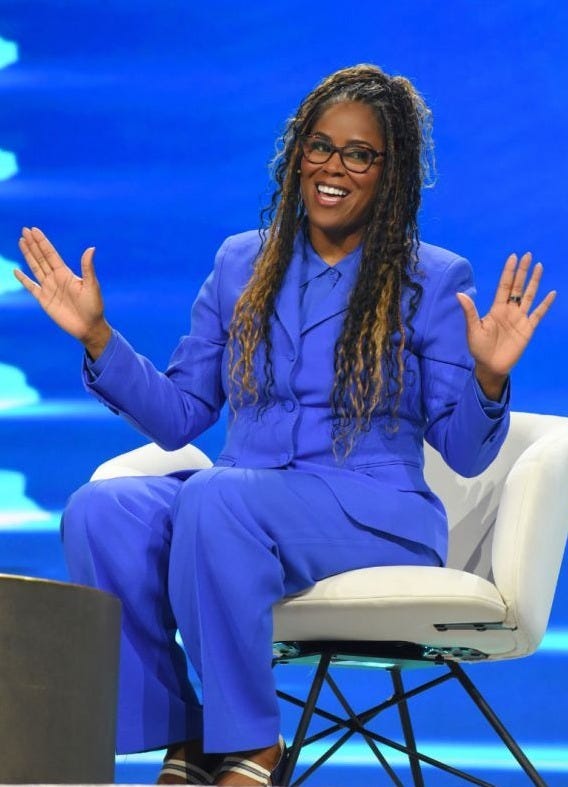
Think about a woman like Thasunda Brown Duckett. I am not interested in pretending I know what is happening inside her closet, but I find her public style interesting for precisely this reason. There is a consistency to the way she presents herself that allows her clothes to support her presence rather than compete with it. You get a sense of polish, authority, femininity and intention, but the clothes do not need to be wildly different every time for that impression to change. The consistency is part of the communication.
And that matters for the women I work with because most of them are not getting dressed simply to look fashionable. They are getting dressed to move through a very full life: leading a team, walking into a boardroom, giving a presentation, traveling for work, going to dinner, attending an event where they know they will see the same people again. They need a wardrobe that can support all of those versions of themselves while still feeling like the same woman.
That is where the idea of a “signature style” becomes much more interesting than simply finding a signature piece. Because if you want people to eventually think, That looks like her, you have to give them something to recognize.
Your Closet Is Giving You More Information Than You Think
This is also the part of personal style that is difficult to teach yourself.
When you are standing in your closet every morning, you see individual pieces. You see the blouse, the trousers, the jacket, the shoes. It is much harder to step back and see the patterns across all of them. You may not realize that you have been buying the same silhouette for five years because you are looking at five different garments. You may not realize that you have a very specific color palette because the colors are distributed across an entire wardrobe.
This is one of the reasons I find wardrobe editing so much more interesting than simply shopping. Shopping can give you more options. Editing helps you understand what the options should actually be.
And once you understand that, outfit repeating starts to feel very different.
You can wear the same trousers three times in one week without feeling as though you have worn the same outfit three times, because the trousers are not the point. They are one of the consistent pieces in a larger language. Change the knit, change the shoe, add the jacket, change the proportion, and suddenly the outfit has a different feeling while still belonging unmistakably to you.
That, to me, is the sweet spot: enough repetition that your style becomes recognizable, enough variation that it remains interesting.
So if you have been looking at your wardrobe and thinking that you need more outfits, I would actually start somewhere else.
Look at what you are already repeating. Which pieces do you reach for without thinking? Which silhouettes make you feel most like yourself? Which combinations have you recreated in slightly different versions? Which purchases have you made more than once, even though you didn’t consciously set out to?
And perhaps the most revealing question: What do you wear when you know you need to feel like yourself?
There is probably a style story hiding in those answers.
You may discover that you don’t need to become more creative with your wardrobe. You may simply need to become more aware of the patterns you already have, and then build around them deliberately.
Because the women whose style stays with us are rarely memorable because they never repeat themselves. They are memorable because, even when the outfit changes, there is something about the way they put themselves together that remains familiar.
That is the part worth paying attention to.
If you’re feeling stuck in your wardrobe,
this is exactly the kind of work I love doing with clients.
xx,