

There is a very specific kind of frustration that comes from standing in front of a full closet and feeling like none of it is right.
It is not that you lack options. In fact, most women I work with have more than enough clothing. The issue is that their wardrobe no longer reflects who they are, how they live, or how they want to show up. Pieces that once worked begin to feel disconnected, and getting dressed becomes something you have to think through rather than move through.
When that happens, the instinct is to buy something new. Something that might fix the feeling. But adding more without creating clarity first almost always leads back to the same place.
This is why every transformation I guide begins with an edit. Not a surface-level clean out, but a deliberate reset, one that allows you to see your wardrobe clearly and rebuild it with intention.
Spring is here, the perfect time to dive in. If you are going to do this on your own, I want you to move through it the same way I would guide you in person.
Step 1: Remove Everything and Work by Category
Start by taking everything out of your closet and grouping it by category. Pants together, tops together, dresses together. This is less about organization and more about visibility.
Most wardrobes are experienced in fragments. You see one piece at a time, usually in a rush. What you don’t see are the patterns, how many versions of the same item you own, where you default, and where you’re overcompensating.
When everything is in front of you, those patterns become difficult to ignore. As you do this, pause and take stock.
Ask yourself:
Where do I clearly have more than I need?
Which category feels repetitive?
Where does it feel like something is missing entirely?
Do my categories have clear functions/roles in my wardrobe?
You are not making decisions yet. You are simply starting to see your wardrobe as a whole.
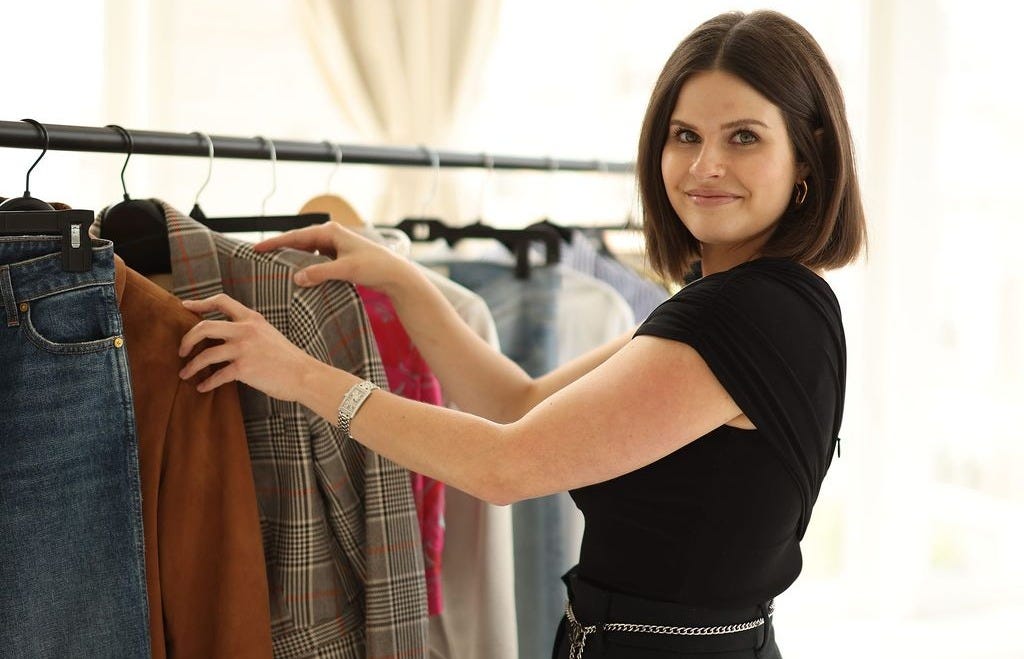
Step 2: Try Everything On and Pay Attention to What Actually Works
This is the step that changes the outcome.
Trying things on forces honesty. It removes the version of the piece you think you have and replaces it with what is actually in front of you. As you move through each category, pay attention not just to whether something fits, but how it feels to wear.
There is a difference between something technically fitting and something working.
As you’re trying pieces on, consider:
Does this feel like how I want to show up today?
Am I adjusting it constantly, or does it sit the way it should?
If I were getting dressed quickly, would I reach for this? Can I style this 5 ways?
You will likely notice yourself wanting to justify certain items. Pieces you used to love, items you spent money on, or things you feel you should be able to make work.
This is where most wardrobes get stuck.
Wearing something that is no longer aligned—whether because of fit, quality, or style—does not serve you simply because you own it. It adds friction to your daily routine and lowers the overall standard of your wardrobe.
Step 3: Set a Clear Standard for What Stays
At this point, you need to make decisions with consistency.
If a piece is stained, stretched, pilled, or past its life cycle, it should be removed. These are not neutral items; they actively bring down everything around them.
If you have not worn something in the last two years, it is worth questioning why. Not in a hypothetical sense, but in a practical one. Your life has given you enough data.
And when you come across a piece you are unsure about, ground yourself in reality.
Ask yourself:
When did I last wear this, and where was I going?
Can I easily create three outfits with this using what I own today?
Does this support my current lifestyle, or a version of my life that no longer exists?
If the answer is unclear or requires too much effort to justify, it is usually a sign that the piece is not contributing in a meaningful way.
Step 4: Be Honest About the “Maybe” Pieces
This is where the process becomes less about clothing and more about mindset.
The “maybe” pile is rarely about the item itself. It is about hesitation. It often reflects a belief that you might need it, or that you won’t be able to find something better.
I have seen this shift happen in real time with clients. One client held onto a significant number of “maybe” pieces during our first edit because she was unsure what would replace them. By the time we worked together again, she let them go easily. Not because her wardrobe had dramatically changed, but because she had experienced what it felt like to have fewer, better options that actually worked.
If you find yourself holding onto something out of uncertainty, it is worth naming that directly. As my best friend always tells me, “saying no to one thing means saying yes to another,” this applies in life and wardrobes.
Pause and ask:
Am I keeping this because I wear it, or because I’m unsure what I would replace it with?
If I saw this in a store today, would I buy it again?
Is this helping me get dressed, or making it harder?
Those answers tend to be more honest than the initial instinct to keep it.

Step 5: Notice What Improves When You Have Less
As you begin removing pieces, something subtle but important starts to happen.
You create space, not just physically, but mentally. It becomes easier to see your options, and easier to combine them. Outfits that once felt unclear begin to take shape more quickly.
I had a client who removed over five full bags from her closet and replaced very little at first. What surprised her most was how much easier getting dressed became. With fewer distractions, she was able to use what she had more effectively. She became more creative, not less.
This is often the opposite of what people expect. You are not limiting yourself by having less. You are refining your options so they actually work together.
Step 6: Identify Your Gaps with Intention
Only after you have edited should you begin thinking about what is missing.
This is where restraint matters. The goal is not to immediately fill space, but to understand it. There are two types of gaps you should be looking for.
The first are functional, pieces that would make your current wardrobe easier to use. The second are alignment gaps, what is missing between how you are currently dressing and how you want to present yourself.
Being able to distinguish between these two is what prevents overbuying.
As you assess, ask yourself:
What piece would make multiple outfits easier to wear?
Where do my outfits consistently fall short?
What am I trying to achieve stylistically that I don’t yet have support for?
Write these down as a list. This becomes your filter when you shop. Because the goal is not to buy more. It is to buy better.
A Final Thought as You Go
You can absolutely take this process on yourself, and if you move through it thoughtfully, you will see a shift.
But it is also worth recognizing what is harder to see from the inside.
A true wardrobe edit is not just about what you remove. It is about how everything works together once it remains. It is about proportion, cohesion, and understanding how to build outfits in a way that feels effortless.
If you have tried this before and found yourself back in the same place, it is not a lack of effort. It is that this process, when done well, is both practical and strategic.
Start here. Move slowly. Pay attention.
And if you reach the point where you want your wardrobe to feel fully resolved, where getting dressed becomes easy in a way it hasn’t before, that is the work I step into with my clients.
Here’s to a killer spring wardrobe!
xx,